
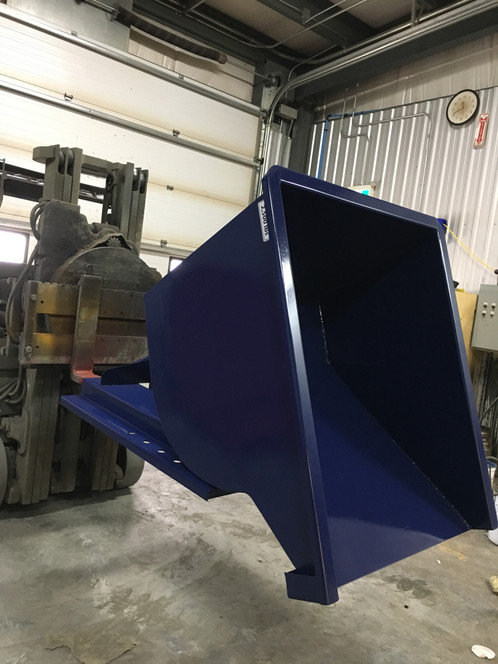
A Complete Buyer’s Guide for Warehouses, Manufacturers & Scrap Operations
Self-dumping hoppers are one of the most efficient ways to handle scrap, waste, and bulk materials in industrial environments. But choosing the wrong size, steel thickness, or dumping style can cost you time, money, and even damage equipment.
At PAXX Industrial Supply Ltd., we help Individuals and businesses across Calgary and Western Canada choose the right hopper every day. This guide walks you through exactly what to consider before purchasing.
- What Material Are You Dumping?
This is the most important starting point.
Light Materials
- Cardboard
- Packaging waste
- Plastic
- Light manufacturing scrap
- Dust Collection
➡ A lighter-duty hopper (10-gauge sides with 3/16" bottom) is typically sufficient.
Heavy Materials
- Scrap steel
- Machined parts
- Castings
- Wet material
- Gravel or dense debris
- Granite Concrete
➡ You may need reinforced steel, thicker sides, or higher weight capacity.
Tip: If you’re regularly dumping dense metal, don’t undersize. The hopper will take abuse over time.
- Choose the Right Capacity
Capacity affects both productivity and forklift safety.
Common Sizes:
- 1/4 Cubic Yard – Small shops, tight spaces, conveyor accumulation
- 1/2 Cubic Yard – Light industrial use CNC chip and part collection
- 3/4 Cubic Yard – Moderate scrap volume, Cabinet shop router scrap collection
- 1 Cubic Yard – Most popular for manufacturing scrap and waste facilities
- 1.5 Cubic Yard- When a higher capacity is needed with a relatively compact footprint Thhis is usually the start for dust collection hoppers
- 2 - 5 cubic Yard- This is when material and forklift capacity really are important If it’s your first purchase contact us for options and recommendations.
Ask Yourself:
- How often do you want to empty it?
- What is the weight of a full load?
- Can your forklift safely lift it when full?
A 1 cubic yard hopper gives double the capacity of a 1/2 yard for only slightly more footprint — often the better value long term with minimal cost difference.
- Match It to Your Forklift
Never choose a hopper without checking your forklift specs.
Key Things to Confirm:
- Fork length
- Fork width
- Fork capacity at load center
- Mast height (for dumping clearance)
If your forklift is undersized, a full hopper becomes a safety hazard.
At PAXX, we always ask for forklift make/model before recommending a unit.
- Steel Thickness Matters
This is where many buyers cut corners.
Our Standard industrial build:
- Bottom: 3/16" plate
- Sides: 10-gauge steel
If you’re handling scrap metal or heavy materials daily, consider heavier reinforcement.
Cheaper imported units often use thinner steel — they look similar but won’t last under abuse.
- Consider Optional Features
Depending on your application, you may want:
- Casters for mobility
- Locking lids
- Heat-treated components
- Liquid-tight welds
- Custom colors for facility organization
If you’re running multiple departments, color coding improves identification and workflow efficiency.
- Indoor vs Outdoor Use
Outdoor applications may require:
- Powder coating
- Drain holes
- Rust-resistant finishes
Calgary weather can be harsh — protection matters.
- Safety & Compliance
Look for:
- Secure fork pockets
- Positive locking mechanisms
- Stable base design
- Clearly marked load capacity
An overloaded hopper is a serious workplace risk.
- Where It’s Manufactured
Canadian-made hoppers typically offer:
- Better steel quality
- Tighter weld standards
- Faster lead times
- Easier warranty support
Imported units can be cheaper upfront but often cost more over time.
Final Checklist Before You Buy
✔ What material am I dumping?
✔ How heavy is a full load?
✔ What forklift am I using?
✔ How often will it be emptied?
✔ Indoor or outdoor use?
✔ Do I need casters or lids?
If you answer those correctly, you’ll avoid 90% of purchasing mistakes.
Need Help Choosing?
At PAXX Industrial Supply Ltd., we help customers across Alberta and Western Canada select the right self-dumping hopper for their exact application.
If you’re unsure, simply provide:
- Forklift make & model
- Material type
- Estimated load weight
- Postal code for shipping
We’ll recommend the correct size and build — no guesswork.
Shop Self-Dumping Hoppers
PAXX Industrial Supply manufactures heavy-duty steel self-dumping hoppers designed for forklifts used in warehouses, manufacturing plants, and construction sites across Canada.
• 1/4 Cubic Yard Self-Dumping Hopper
• 1/2 Cubic Yard Self-Dumping Hopper
• 3/4 Cubic Yard Self-Dumping Hopper
• 1 Cubic Yard Self-Dumping Hopper
• 1-1/2 Cubic Yard Self-Dumping Hopper
• 2 Cubic Yard Self-Dumping Hopper
• 2-1/2 Cubic Yard Self-Dumping Hopper
• 3 Cubic Yard Self-Dumping Hopper
• 4 Cubic Yard Self-Dumping Hopper
• 5 Cubic Yard Self-Dumping Hopper